
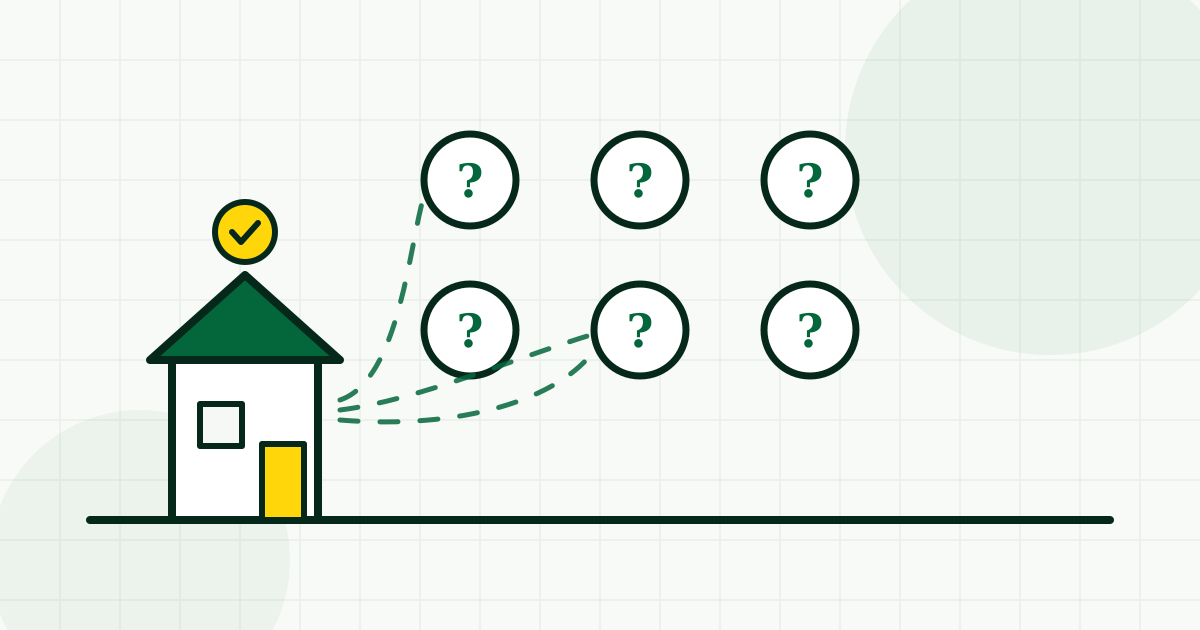
Finding a house in the UK takes an afternoon. You open a property portal, set a price ceiling, tick “2+ bedrooms”, and there they are: photographs, floor plans, a school-run distance someone has typed in, and an agent who will call you back within the hour.
Finding out what it is like to live there takes weeks, and most people never really finish the job. They move in and learn the answers afterwards — the bin lorry that comes at half five, the GP list that is closed to new patients, the broadband that tops out at 12 Mbps on a street where the listing said “superfast available”.
That gap is the reason MoveCompass exists. The property market has spent twenty years getting very good at selling you a building. Almost nobody has done the equivalent work on the thing you are actually buying, which is a postcode.
The listing tells you about the house. It does not tell you about the street
Read a property listing closely and notice what it is measuring. Square footage. Bedrooms. Tenure. Council tax band. EPC rating. Chain status. Every one of those is a fact about the structure or the transaction.
Now write down the questions that actually kept you up last night:
- Will my daughter get into a decent secondary school from this address, or is she four streets outside the catchment?
- How long is the wait at the nearest GP surgery, and is it even taking new patients?
- Is this a quiet street with a low-level burglary problem, or a quiet street with a genuine one?
- Can I work from here on a video call at 4pm on a Thursday?
- Is the nearest supermarket a ten-minute walk or a car journey I have not budgeted for?
- Did that river flood in 2007, and is anyone going to tell me if I do not ask?
Not one of those is answered by the listing. Some of them are answered badly by the listing, which is worse, because “excellent schools nearby” and “good transport links” are marketing phrases with no definition behind them. Nearby to whom? Good compared to what?
The estate agent is not lying. They are doing a different job. Their job is to sell one building, and they are paid by the person who owns it.
The information exists. It is just scattered across thirty government websites
Here is the frustrating part. Almost everything on that list above is public. The UK publishes an extraordinary amount of open data about places, and the quality is genuinely high:
- police.uk publishes every recorded street-level crime, monthly, by category and outcome.
- The Department for Education publishes every school, its inspection judgement, and how much pupils improve between primary and their GCSEs.
- NHS registers publish every GP surgery, pharmacy, dentist and hospital, with its address.
- Ofcom publishes broadband and mobile coverage down to the premises.
- HM Land Registry publishes every sold price in England and Wales.
- The Food Standards Agency publishes every hygiene inspection.
- The Environment Agency publishes live flood warnings.
- MHCLG publishes energy certificates.
So the data is not missing. What is missing is anybody doing the boring work of putting it in one place, for one postcode, at the moment you need it.
Try it yourself for a single address and you will see the shape of the problem. Every dataset uses a different geography — some by postcode, some by ward, some by local authority, some by a thing called an LSOA that nobody outside statistics has heard of. Some are CSV downloads the size of a film. Some have an API that needs a key and a registration form. Some cover England only, because education and policing are devolved, so Scotland and Northern Ireland publish theirs somewhere else entirely, on a different measure, at a different time of year.
A determined person with a free weekend can do this for one postcode. Nobody does it for the six postcodes on their shortlist, and that is exactly when it would change the decision.
Why the obvious shortcuts do not work
Asking a local Facebook group. You get opinions, which are real but not representative. The three people who reply are the three people with the strongest feelings.
Driving around on a Saturday. You see the street on a Saturday. You do not see the Monday commute, the Tuesday bin day, the Friday night.
“Best places to live” lists. These rank whole towns. You are not buying a town. Two streets a mile apart in the same town can differ more than two towns in different counties.
Area guides on property portals. These are usually marketing pages with a paragraph of copy and a school list. Check who wrote it and who benefits if you move there.
Asking an AI chatbot. Better than it used to be, and genuinely useful for framing the question. But ask one for the crime rate on a specific postcode and you will often get a number that sounds plausible and is not traceable to anything. A confident wrong answer about where you are going to live for ten years is the worst of both worlds.
What we actually built, and the rule we set ourselves
MoveCompass is one search box. You put in a postcode, and it assembles what the official sources say about that exact postcode: schools with their inspection judgements and how far away they are, GPs and pharmacies, hospitals, recorded crime by type and month, broadband speeds available, sold prices, council tax, rents, food hygiene ratings, flood warnings, EV chargers, bus stops and stations with the routes that call there, and who your MP is.
That description would fit a dozen products. The part that matters is the rule underneath it.
Every number has to trace back to a named source, or we do not show it.
That sounds obvious. In practice it is the hardest constraint in the whole project, because it means saying “we do not have this” far more often than a marketing person would like. A few examples of what it costs us:
- Crime in Scotland. police.uk does not cover Scotland — Police Scotland publishes separately, on a different basis. So for a Scottish postcode, the crime tool says exactly that. It would be trivial to show an empty chart instead. An empty chart reads as “no crime here”, which is a lie told by omission.
- Sold prices in Scotland and Northern Ireland. Held by Registers of Scotland and Land & Property Services, not HM Land Registry. Same answer: we say so.
- School rankings across the four nations. England publishes Progress 8. Scotland, Wales and Northern Ireland measure different things. You cannot honestly rank a school in Fife against a school in Leeds, so we rank each nation within itself and name the measure each one uses, rather than inventing a single UK league table that would be nonsense.
- Estimates. We do not model, smooth or “enhance” anything. If a dataset covers the area, you get the figure and the date it was published. If it does not, you get told.
The second rule follows from the first: say what a check means, and what it does not. In our trades directory we see a photo ID and an insurance certificate before a listing goes live, and the listing switches off automatically the day that insurance expires. We do not vet quality of work and we do not check criminal records — so the page says that, in plain words, next to the businesses. A tick with an unclear meaning is worse than no tick.
The thing that surprises people: the data changes the shortlist
The reason any of this matters is not tidiness. It is that looking at six postcodes side by side rearranges them.
People arrive at MoveCompass with a favourite. They have seen the house, they like the kitchen, and they are looking for confirmation. What they often find instead is that the postcode two miles down the road — the one they had nearly crossed off because the photos were worse — beats it on the measures that will actually shape the next ten years: a faster broadband tier, a secondary school with a much stronger Progress 8, a GP surgery taking new patients, and noticeably less recorded burglary.
That is a decision changed by data. Not by an opinion, not by a ranking, and not by us: we do not score areas or tell anyone where to live. We put the numbers next to each other and name where each one came from.
As of September 2026 MoveCompass holds 1,796,277 UK postcodes, 931,323 mapped places — schools, hospitals, GP surgeries, food premises, transport stops, post and parcel points — and 1,737,468 broadband coverage records, across all 361 local authority districts. Every one of those figures is a count from our own database, not an estimate.
What this means if you are moving
If you take nothing else from this article, take the working method rather than the product:
- Shortlist postcodes, not houses. Houses come and go. The postcode is what you are stuck with.
- Check the things that are expensive to fix. You can replace a kitchen. You cannot move the catchment boundary, the broadband cabinet or the GP list.
- Ask for the source of every number you are given. By an agent, by a chatbot, by us. If nobody can tell you where a figure came from, treat it as an opinion.
- Compare two or three seriously, rather than researching your favourite and glancing at the rest. The comparison is where the surprise lives.
- Check the boring ones. Flood risk and broadband are the two people skip, and the two that most often turn into a real problem after they have moved.
Conclusion
Finding a house is a solved problem. Photographs, floor plans, filters and a hundred portals compete to do it for you, and they do it well.
Choosing where to live is not solved, because the thing you are really choosing — the street, the school, the surgery, the signal, the walk to the shop — is scattered across dozens of official datasets that were never built to be read together by a person with a shortlist and a fortnight to decide.
MoveCompass is our attempt at the unglamorous half of that job: gather the public data, tie every number to the body that published it, show it for one postcode at a time, and say plainly when we do not have something. No scores, no “best places” rankings, no estimates dressed up as facts.
You still make the decision. You just get to make it with the same information the data was always meant to give you.
Try it with the postcode you are considering — and with the one you live in now, which is the honest test of whether it tells you anything you did not already know.


Comments
Loading…
Comments are open to members, so every one is attached to a real account.