
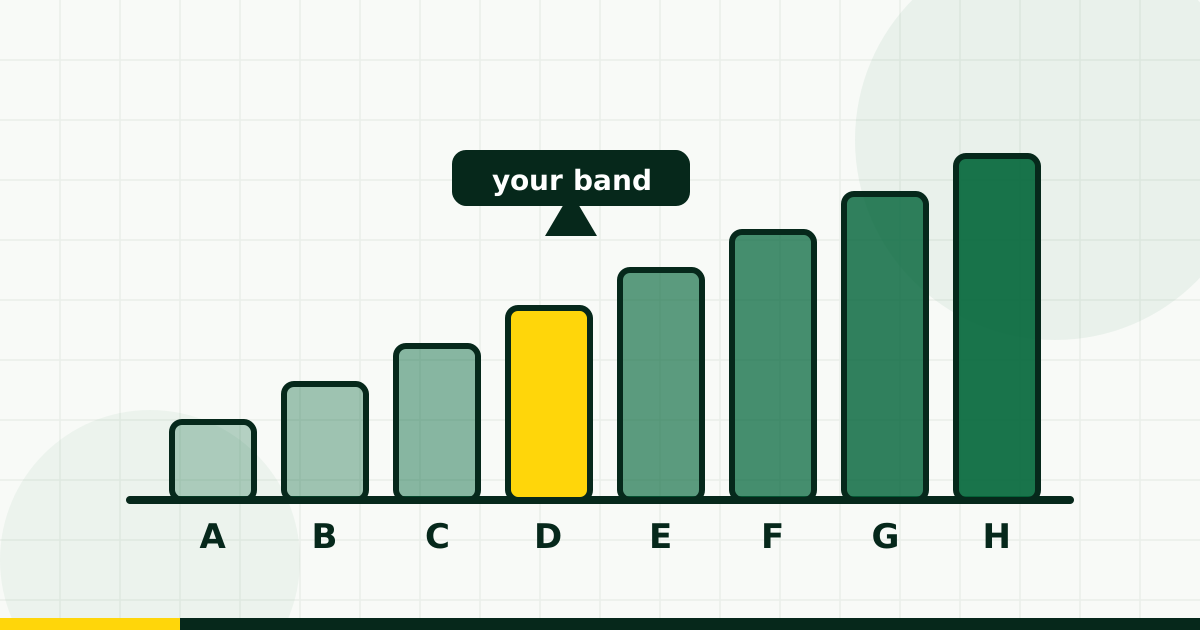
Every listing, every area guide and every comparison site quotes a council tax figure. Almost none of them are quoting what you would pay. The number is nearly always Band D, and Band D is a benchmark rather than a typical home.
What the bands actually are
Every home in England and Scotland sits in one of eight bands, A to H. Wales has nine, A to I. The band is set by what the property was worth on a single day: 1 April 1991 in England and Scotland, 1 April 2003 in Wales.
That date matters more than people expect. A house built in 2015 is still given a band based on what it would have been worth in 1991, had it existed. Two identical houses on the same street are in the same band even if one has been extended twice since — until it is sold, at which point the extension can trigger a review.
Northern Ireland does not use bands at all. It kept domestic rates, calculated from the property's capital value as at January 2005, and the bill is worked out as a percentage of that value rather than by band.
Why Band D and not the average
Band D is the reference point every council uses to publish its rates, and every other band is a fixed proportion of it. Band A is six-ninths of Band D. Band H is twice it. So a council announces one Band D figure and every other band follows arithmetically.
It is a benchmark, not a description. In much of the north of England most homes are in Bands A and B, so quoting Band D describes a house more expensive than most of the street. In parts of London and the South East the opposite is true.
If you want the figure that applies to you, you need two things: the band of the specific property, which is public and searchable on the Valuation Office Agency's site, and the council's rate for that band, which every council publishes.
The discounts that change the number
The published figure assumes two adults living in the property. Several situations reduce it, and they are worth knowing before you assume a bill is unaffordable:
- Living alone — a 25% single person discount. This is the big one, and it applies to a great many households.
- Everyone in the house is a full-time student — usually no council tax at all.
- Someone in the house has a severe mental impairment — they are disregarded for counting purposes, which can mean a discount or an exemption.
- A live-in carer, or an apprentice on low pay, may also be disregarded.
- An empty property can attract a discount for a period, though many councils now charge a premium on homes left empty long term rather than a discount.
What the bill actually pays for
In a two-tier area — most of shire England — your bill is not one charge but several stacked together. The district council collects it, but it is passing most of it on:
- The county council, which usually takes the largest share and pays for social care, schools support and roads.
- The police and crime commissioner.
- The fire authority.
- The district council itself, often the smallest share, covering bins, planning and housing.
- A parish or town council, where one exists, adding a small local precept.
This is why the same band costs different amounts a few miles apart. Crossing a county boundary changes the largest component of the bill.
Challenging a band
Bands can be wrong, and a surprising number are. The original 1991 valuations were done quickly, sometimes from a car window, and errors have propagated ever since.
You can ask the Valuation Office Agency to review a band, free of charge. Two warnings, though. A review can move a band up as well as down, and it applies to the property rather than to you — so a successful challenge that lowers the band lowers it for the neighbours too, and an unsuccessful one that raises it raises it for you alone.
The usual evidence is that similar properties on the same street are in a lower band. If yours is the only Band E on a road of Band Ds, that is worth asking about. If the whole street is Band E, it probably is not.
What we show, and what we do not
MoveCompass shows the Band D figure for the local authority covering each postcode, from the annual figures published by MHCLG. We show it because it is the only figure that is comparable between areas — it is the same benchmark everywhere.
We do not show your bill, because we cannot. That depends on the band of a specific property and on who lives in it. Treat our figure as a way to compare one area against another, then look up the actual band before you commit to anything.
Scotland and Wales publish their council tax figures separately from England, and we say so rather than leaving the card blank without explanation.

Comments
Loading…
Comments are open to members, so every one is attached to a real account.