
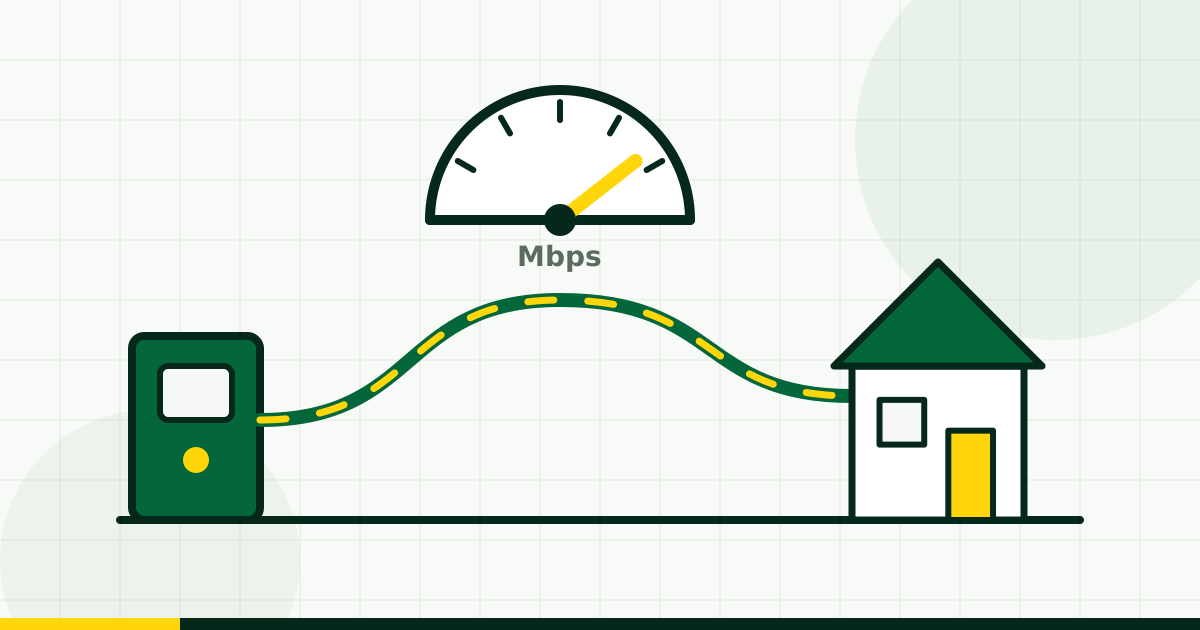
"100% gigabit available" is one of the more misunderstood figures on any area report. It does not mean the internet in that postcode runs at a gigabit. It means every premises there could order a service capable of it, if they chose to and were willing to pay.
Availability is a question about infrastructure
Ofcom collect these figures from the network operators twice a year. Each operator reports which premises their network can serve and at what capability. Ofcom aggregate that to postcode level and publish it.
So the figure answers one question: has somebody built a network here that can do this? It says nothing about how many people have taken it, what they pay, or how the connection performs at seven in the evening.
The tiers you will see are:
- Superfast — 30 Mbit/s or more. This has been near-universal for years, so a low figure here is genuinely unusual and worth investigating.
- Gigabit-capable — 1,000 Mbit/s or more. Usually full fibre or cable.
- Below the USO — cannot get a decent connection at all. The Universal Service Obligation sets a floor, and a postcode above zero here has a real problem.
Why your actual speed will be lower
Between the availability figure and the speed on your laptop sit several things, most of which nobody mentions when you sign up:
The package you buy. A gigabit-capable line sold as a 150 Mbit/s package delivers 150. Availability is the ceiling, not the product.
The technology. Full fibre runs to the property. Part-fibre stops at a street cabinet and covers the last stretch over copper, and that stretch degrades with distance — a few hundred metres makes a substantial difference.
Contention. Networks are shared. The advertised figure is usually an average at peak time for at least half of customers, which is a lower bar than it sounds.
Your own wiring and router. A fast line into a house with a router in a cupboard behind a wall arrives at the far bedroom as something much slower. This is the single most common reason a connection disappoints, and it is the one thing entirely within your control.
The figure Ofcom do not publish at postcode level
People often ask why we do not show an average speed for their postcode. Ofcom do not publish one at that granularity, and neither do the operators. What is measured and published is availability and take-up, not the speed households actually receive.
We could estimate one. We do not, because an estimate presented next to genuinely measured figures would look equally solid and would not be.
What to do before you commit to a property
Check the availability for the specific address rather than the postcode — a new-build at the end of a street can have entirely different infrastructure from the Victorian terraces on it. Every major provider has an address checker.
Ask the current occupant what they actually get and who from. It is the fastest way to learn something no dataset will tell you.
If you work from home, check the upload speed as well as the download. Video calls need upload, and part-fibre connections are often dramatically asymmetric — 60 down and 10 up is common, and it is the 10 that decides whether you look frozen on a call.
Mobile signal is a separate question
Ofcom publish mobile coverage in the same release, and it behaves quite differently. Indoor coverage is often much worse than outdoor, thick walls matter enormously, and a postcode with excellent outdoor 4G from every network can have no usable signal inside a stone cottage.
Both figures are predictions from operator models rather than measurements taken at the door. They describe the shape of an area well, and a specific address only roughly.


Comments
Loading…
Comments are open to members, so every one is attached to a real account.