
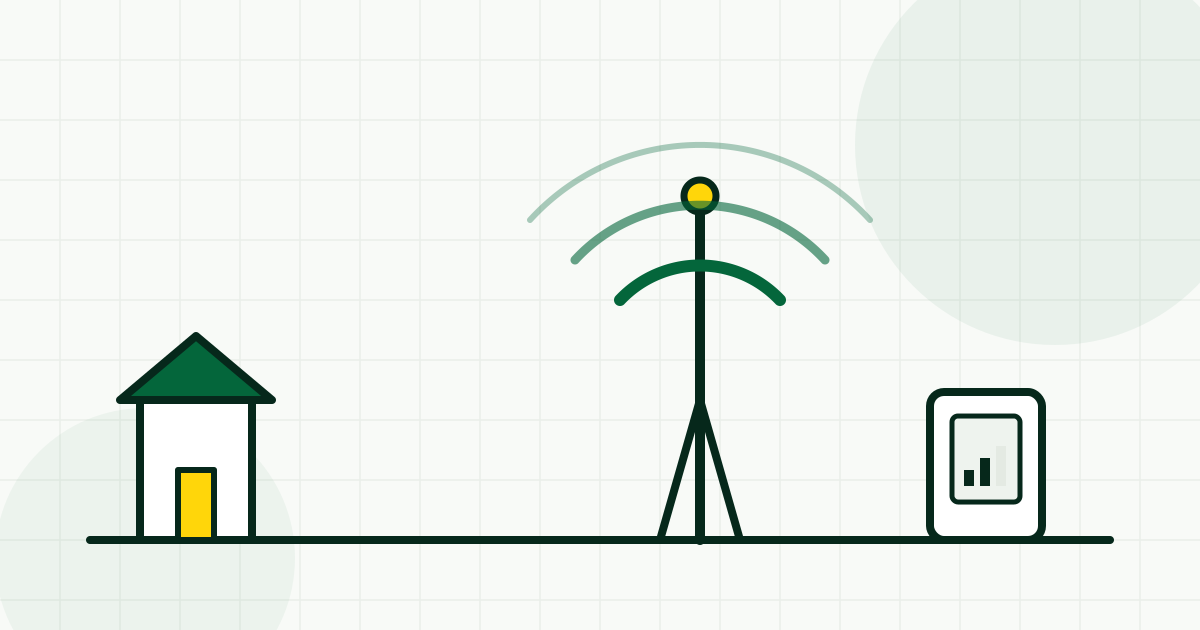
People check broadband before they move. Almost nobody checks whether their phone works in the kitchen, and that is the one they notice on the first evening — standing by a window, holding a handset up, discovering that the room they liked most is the room with no bars in it.
It is a strange gap, because mobile signal fails more visibly than broadband and is far harder to fix. You can change broadband provider. You cannot change where the mast is.
What the published figures actually measure
Ofcom publishes mobile coverage as part of Connected Nations, and it is genuinely good data — but read what it is measuring before you lean on it.
It is a predicted share of premises with coverage from each of the four networks, and the headline figures describe outdoor reception. Our area report shows Ofcom's figures at local-authority level, with the date they were published, because that is the geography Ofcom publishes them at. It is a good way to rule an area in or out. It is not a reading taken at your front door, and we would rather say so than let a tidy "100%" imply something it cannot support.
Once you have a shortlist of specific addresses, Ofcom's own checker will give you a prediction for that address, which is the next step up in precision.
Indoors is a different question entirely
This is where most disappointment comes from. Outdoor coverage and indoor coverage can differ enormously at the same address, and the things that cause it are exactly the things a modern buyer wants:
- Foil-backed insulation board, which is close to a mirror for radio signal.
- Modern coated glazing, which has a metallic layer.
- Thick stone or solid brick walls in older properties.
- Basements and ground-floor flats with a building above and around them.
A well-insulated new build in an area with excellent outdoor coverage can be one of the worst indoor signal environments you will encounter. That is not a fault in the data. It is the data measuring something else.
Check all four networks, not just yours
The instinct is to check your own network and stop. Do the opposite, for one practical reason: switching network is easy and moving house is not.
If three networks cover an address well and yours is the one that does not, that is a £10 problem. If all four are poor, that is a fact about the building you will live with for years. Those two situations look identical if you only checked one network.
The test that actually settles it
Everything above narrows the field. One thing decides it, and it takes ninety seconds on the viewing:
- Stand inside, not on the doorstep. Signal at the front door tells you about the street.
- Go to the room that matters — the one you would work in, or the kitchen where you actually take calls.
- Make a call. Bars are a rough indicator and a notoriously flattering one. Thirty seconds of speech tells you more than five bars.
- Try upstairs and downstairs. A floor can be the whole difference.
- Ask the agent or the seller which network they are on and whether they use Wi-Fi calling. It is an innocuous question and the answer is often very informative.
If the signal is poor, what then?
Wi-Fi calling is supported by all four UK networks and by nearly every handset sold in the last several years. It routes calls and texts over your broadband, and in a property with poor indoor coverage it is the difference between a problem and a non-problem.
Which is the real reason to check broadband and mobile together rather than as separate boxes: in a building with bad reception, your broadband is your mobile coverage. A poor signal with fast reliable broadband is an inconvenience. A poor signal with slow broadband is a genuinely bad place to work from.
In short
Published coverage figures tell you about an area, honestly, as far as they go. The building decides the rest, and no dataset in the country can see inside it. Use the data to shorten the list, then go and stand in the room.

Comments
Loading…
Comments are open to members, so every one is attached to a real account.