
It sounds like the easiest question in British public administration. How many councils are there?
Ask three reputable organisations today and you will get three different numbers. Not because anybody is wrong, but because the answer is moving while you ask it.
Here is what each one says, with the date attached, because on this question the date is most of the answer.
Scotland, Wales and Northern Ireland: settled
Start with the easy part. Outside England the picture has been stable for years and everybody agrees:
- Scotland — 32 councils. All unitary.
- Wales — 22 councils. All unitary.
- Northern Ireland — 11 councils. All unitary.
Unitary means one council does everything for that area: bins, planning, schools, social care, the lot. If you live in any of the three, you have exactly one council and there is no ambiguity about which.
England: three published figures
England is where it comes apart.
| Source | Councils in England | As at |
|---|---|---|
| House of Commons Library | 307 | 6 May 2026 |
| LGIU | 317 | page updated August 2026 |
| Institute for Government | 333 | August 2022, no longer updated |
These are not careless numbers. The House of Commons Library briefs MPs; the LGIU is the local government think tank; the Institute for Government is a serious research body that has simply stopped maintaining that page and says so on it.
They disagree because councils in England are actively being merged. The government has committed to replacing the remaining two-tier areas with unitary authorities, inviting proposals from councils to combine — with a population of 500,000 or more as a guiding principle. Every time a merger completes, the total drops. Any published figure is a photograph of a moving thing.
We are not going to pick one and call it the answer. What we will say is the thing that actually helps: check the date on any council count you are given. Including this one, which was checked on 25 September 2026.
Why you might have two councils
This is the part that catches people out when they move, and it is more useful than the total.
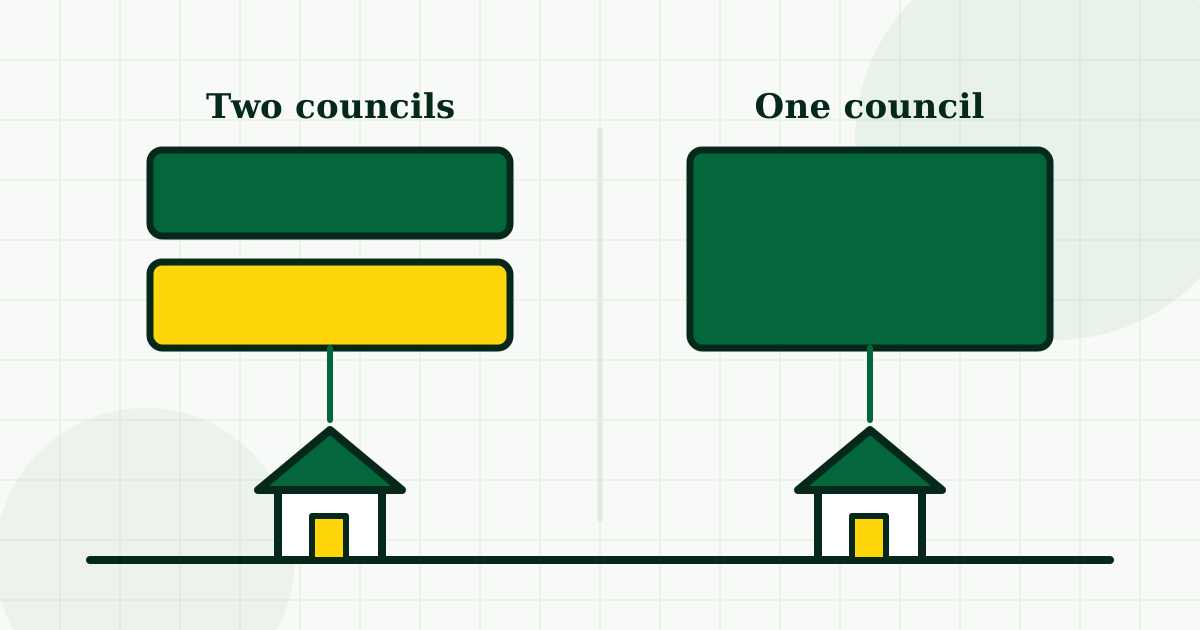
In a two-tier area, two councils cover your house and they do different jobs:
- The county council — schools, social care, main roads, libraries, trading standards.
- The district, borough or city council — bin collections, planning applications, housing, environmental health, and collecting your council tax.
In a single-tier or unitary area — every London borough, every metropolitan borough, the unitary authorities, and all of Scotland, Wales and Northern Ireland — one council does all of it.
The reason most people in two-tier areas do not realise they have two councils is that one bill funds both. Your district collects the council tax and passes the county's share on, along with the police and fire precepts. It looks like one organisation because you only ever pay one of them.
It stops looking like one organisation the first time you try to object to a planning application and get sent to a different council from the one that empties your bin.
What this means when you move
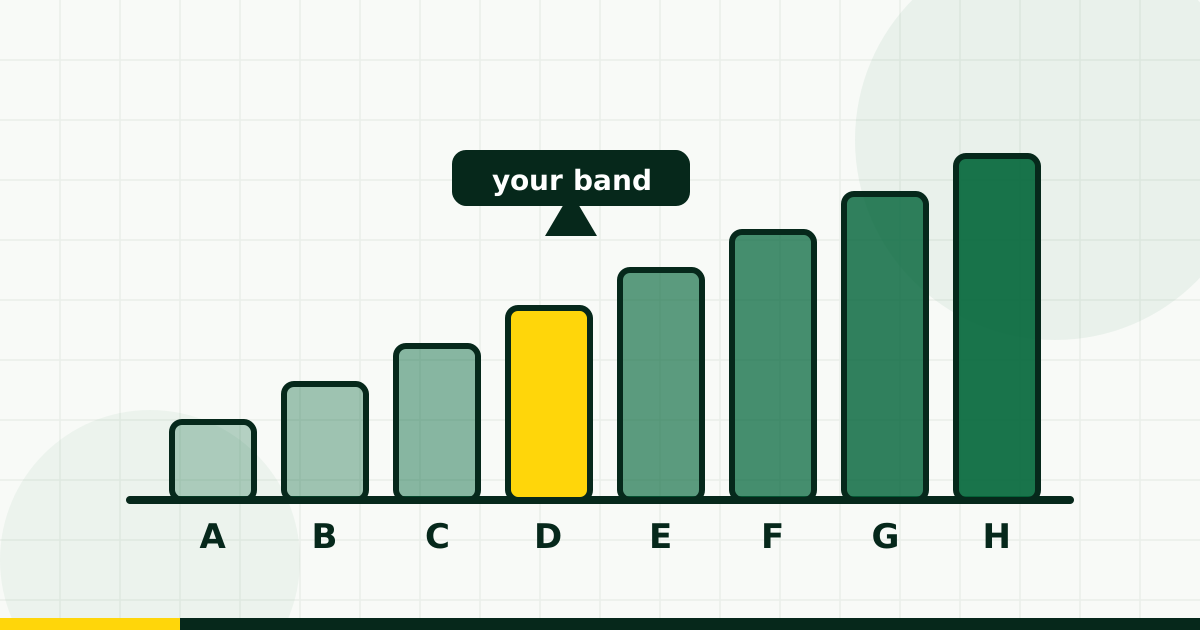
Your council tax bill is set by your council, not by your region. Two addresses a mile apart in different districts can have genuinely different band D figures. That is a permanent difference in what living there costs, and it never appears on a property listing.
School admissions are the county's, not the district's, in a two-tier area. If you are moving for a school, the county council's admissions team is who you need, and their catchment rules are the ones that matter.
Planning goes to the district. If you want to know what has been approved on the field behind the house, that is the district's planning portal — public, free, and the only way to find out before you buy.
A reorganisation may be coming to your area. If you are moving into a two-tier part of England, there is a live possibility that both councils will be replaced by a new unitary. Services usually continue unchanged; the letterhead and the website address do not.
How to find out which council covers an address
GOV.UK has a postcode lookup that names your council — or both of them — and links straight to them. It is the authoritative answer and takes about ten seconds.
Our area report also names the council a postcode falls in, with the band D council tax figure and the year it applies to. We take those figures from the government's published council tax statistics and show the year on the number, for the same reason this article shows dates on the totals: a council tax figure with no year is not information.
What we cannot tell you
We hold the council tax figure per council, not a bill for your specific house — your actual bill depends on your band, your parish precept, and any discount or exemption you qualify for. We do not hold parish precepts, and we say so rather than presenting a band D figure as your bill.
We also cannot tell you whether your council is about to be merged. That is a live political process, and the honest answer is to read your council's own announcements.
In short
Scotland has 32, Wales 22 and Northern Ireland 11, and those have been stable for years.
England has 307, 317 or 333 depending on whose page you landed on and when it was written, because the number is genuinely changing. Anyone who gives you a single confident figure without a date is either lucky or not paying attention.
The more useful question is not how many councils there are. It is which ones cover the address you are thinking about, and what each of them is responsible for — because that is what you will actually deal with.

Comments
Loading…
Comments are open to members, so every one is attached to a real account.