
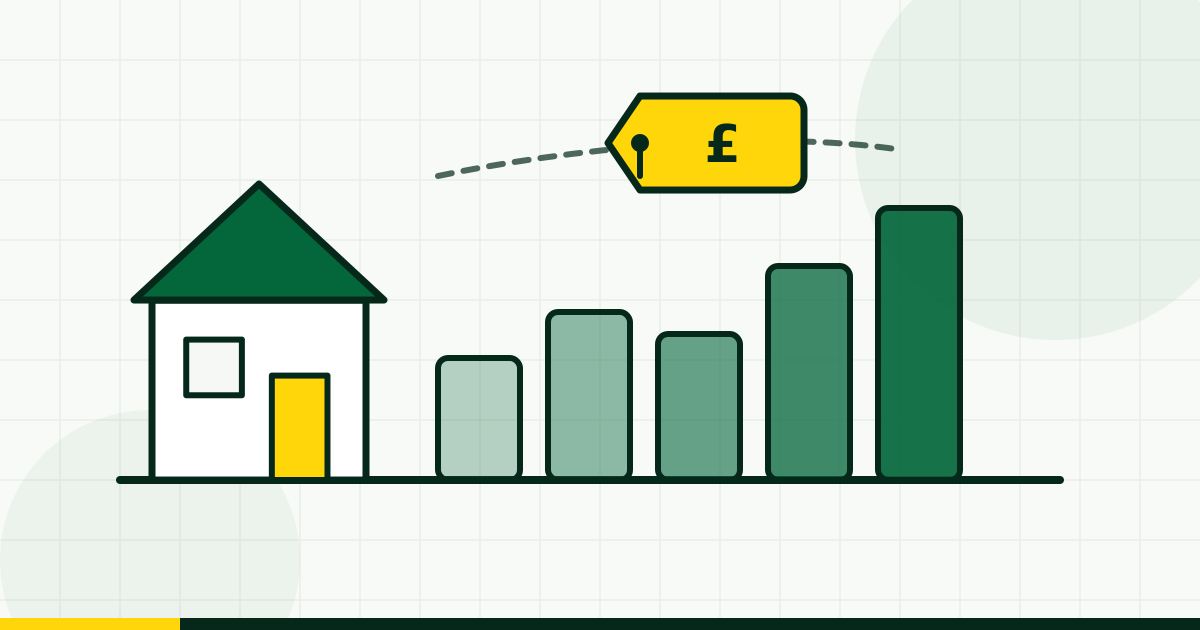
An asking price tells you what the seller hopes for, and what the agent thought would win the listing. The sold prices on the same street tell you what people actually paid. When I look at a house, I check those first.
They are public. HM Land Registry records the price of every residential sale it registers in England and Wales and publishes the lot as open data. Our sold house prices tool reads that data for any postcode. The records are simple, though, and it's easy to read more into them than they hold.
What a record tells you
Each sale gives you the price, the date the sale completed, the address, and a few basic facts: whether the property is detached, semi-detached, terraced or a flat, whether it's freehold or leasehold, and whether it was a new build.
That's all. There's no floor area, no number of bedrooms and no condition. A three-bed terrace that sold for a lot more than the one next door might have a loft conversion, a new kitchen, or just a buyer who fell in love with it. The record can't tell you which.
What it leaves out
Recent sales take a while to appear. A sale is only published once the registration is complete, and that usually lags behind the completion date. If you're viewing today, the last couple of months on your street may not be in the data yet. That matters most when prices are moving quickly.
Not every sale is in there. Transfers where no money changed hands, such as gifts or transfers after a divorce, aren't included. Land Registry also marks some sales as a separate category, for example repossessions and sales to companies, because they don't behave like an ordinary sale between two people. Where the data flags that, we say so.
It covers England and Wales. Scotland keeps its own register, run by Registers of Scotland, and Northern Ireland is separate again. If a tool shows nothing for a Scottish postcode, that's why. It doesn't mean nothing sold there.
How I use it
I don't average the whole postcode. I look for the closest match I can find: the same type of house, ideally on the same street, sold as recently as possible. Two or three good matches are worth more than an average of thirty mixed sales.
Then I look at the dates. A match from five years ago is a starting point, not an answer, so I check whether prices in the area have moved since then. Our sold prices tool shows the history, so you can see which way the street has gone.
If the asking price sits well above every comparable sale, I want to know why before I offer. Sometimes there's a good reason, like an extension or a bigger garden. Sometimes it's just optimism, and the sold prices give you something concrete to say to the agent.
What it can't do
Sold prices don't value a house. A surveyor sees the roof, the damp and the boundary. The data doesn't. Use sold prices to decide whether an asking price is in the right area, then let the survey and the mortgage valuation do their job.
If a figure on our site looks wrong for your street, tell me. I'd rather check it than have you rely on it.


Comments
Loading…
Comments are open to members, so every one is attached to a real account.